
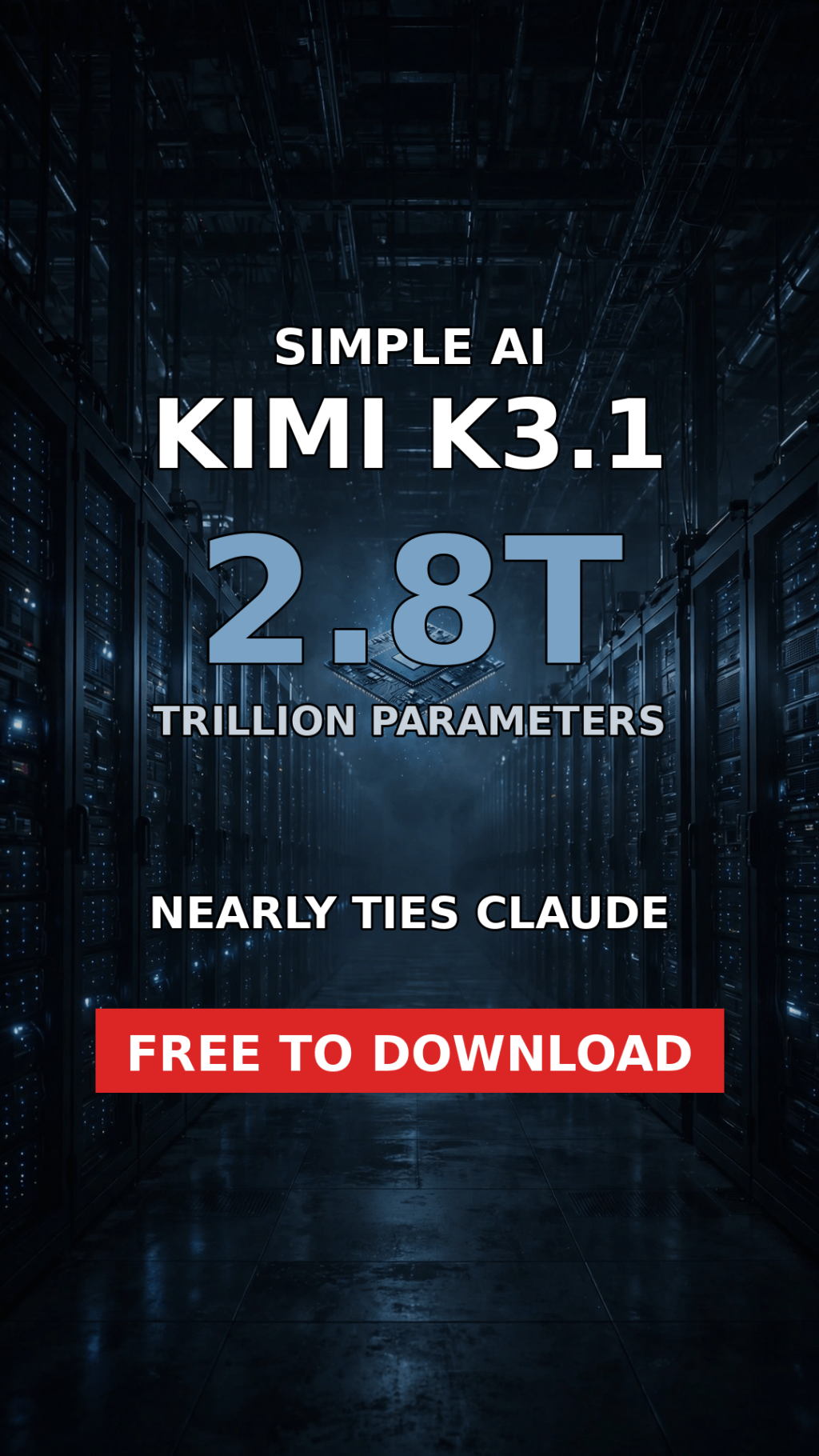
2.8 trillion parameters. Free to download. Nearly beats Claude.
Moonshot kept its promise. On November 4, 2026, the Chinese lab published the full weights of Kimi K3.1 Pro on Hugging Face — the date it set when the model launched on October 23. The repo, moonshotai/Kimi-K3.1-Pro, holds 96 files totalling 1.56 TB: a mixture-of-experts model with 2.8 trillion total parameters, 104 billion active per token, and a 1-million-token context window. By size it is the largest open-weight release to date, ahead of Qwen3.8 at 2.4 trillion and DeepSeek V4 Pro at 1.6 trillion. The model launched in Moonshot’s own apps and API on October 23 at $2 per million input tokens and $10 per million output tokens, down from K3’s $3/$15.
The storyline
Hook: 2.8 trillion parameters. Free to download. Nearly beats Claude.
Context: Moonshot published the full Kimi K3.1 Pro weights on Hugging Face on November 4, 2026, keeping the date it promised at the October 23 launch. The repo moonshotai/Kimi-K3.1-Pro holds 96 files totalling 1.56 TB: a 2.8T-parameter MoE with 104B active per token and a 1M-token context, the largest open-weight release to date.
Stakes: Moonshot’s own Terminal-Bench 4.0 numbers put Kimi at 65.7 against Claude Opus 5.5 at 66.4 and GPT-6 Astra at 58.2 — but those are the lab’s own figures, and the public weights now let third parties verify them. The license is free for nearly everyone, with catches only at big scale.
Payoff: Open weights just got serious. Open or closed — which side are you on?
The catch, in plain terms
Open weights do not mean a laptop model. The 1.56 TB download needs data-centre hardware to run in full, and the weights ship in a compact 4-bit format (MXFP4). The license is free for nearly everyone: use, modification, fine-tuning and redistribution are all free. The catches bite only at big scale — a company selling access to the model as a service with over $20 million in revenue over 12 months needs a separate agreement with Moonshot, and products with over 100 million monthly users or over $20 million in monthly revenue must display the model name.
There is also a gap the headline numbers hide. On Terminal-Bench Science 0.1, Kimi scores 38.1 against 63.3 for Claude Opus 5.5 and 68.1 for GPT-6 Astra — again Moonshot’s own figures. The open weights are what turn those claims into something checkable.
Try it yourself
The model is live in Kimi’s apps and through the Kimi API as kimi-k3.1-pro. The Hugging Face model card shows how to call it — note that multi-turn use requires passing the full assistant message back, including its reasoning content:
import openairesponse = client.chat.completions.create( model="kimi-k3.1-pro", messages=messages, stream=False, max_tokens=4096, reasoning_effort="max",)
(Code from the Kimi K3.1 Pro model card on Hugging Face; the card’s full example also shows preserving reasoning_content and tool_calls across turns.)
Watch next
Claude Code subagents — the next edition in today’s batch.
How we verified this
Checked against the Kimi K3.1 Pro model card on Hugging Face (parameters, context, benchmark table, license link), TechFeatured and The AI News Report (release date, 1.56 TB / 96 files, largest-open-weight claim, license thresholds), and the Moonshot launch record (October 23 launch, $2/$10 API price). All benchmark figures are Moonshot’s own — the model card says so, and the public weights now let independent testers verify them.
Links
- Instagram reel: https://www.instagram.com/p/DfcHs6EgGXY/
- Sources: https://huggingface.co/moonshotai/Kimi-K3.1-Pro · https://techfeatured.com/20688/moonshot-kimi-k3-1-pro-open-weights-download · https://theainewsreport.com/2026-11-04-kimi-k3-1-pro-open-weights-license-hardware-explained.html · https://explainx.ai/blog/kimi-k3-1-pro-open-weights-benchmarks-price-terminal-bench-nov-4-2026
- https://www.instagram.com/simpleaiexplains/
- https://buymeacoffee.com/simpleaiexplains


Leave a Reply