

Anthropic’s AI is improving twice as fast.
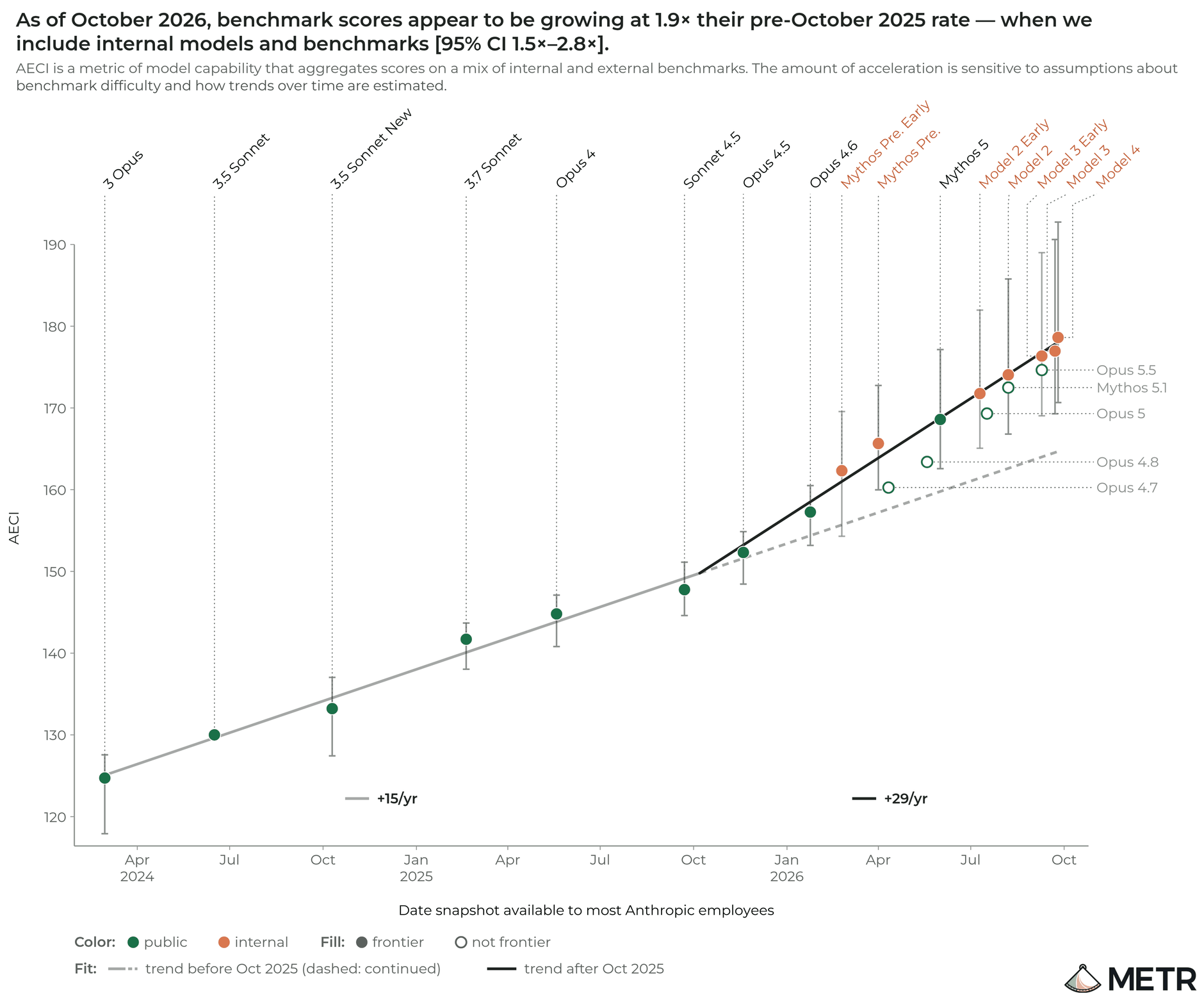
Independent evaluator METR spent eleven weeks inside Anthropic — August 12 to October 29, 2026 — measuring whether AI is speeding up the work of building better AI. Its assessment, published November 5, says yes: benchmark scores for Anthropic’s models have grown 1.9 times faster since October 2025, roughly two years of historical progress packed into a single year. METR credits AI itself for roughly 80 percent of the speedup, and found no bottleneck that would stop it compounding over the next 12 months. But there is a catch: Anthropic redacted a majority of the evidence METR found most informative, so the public has to take the auditors’ word for it. And AI still cannot run model training on its own. Not yet.
The storyline
Hook: Anthropic’s AI is improving twice as fast.
Context: METR, an independent AI evaluator, spent 11 weeks inside Anthropic (Aug 12–Oct 29, 2026) and published its assessment on Nov 5: benchmark scores have grown 1.9 times faster since October 2025, roughly two years of progress in one year.
Stakes: METR credits AI itself for roughly 80% of the speedup, found no bottleneck that would stop it compounding over the next 12 months, but Anthropic redacted a majority of the most informative evidence — and AI still cannot run model training on its own. Not yet.
Payoff: Expect faster models, sooner — and send this to someone who thinks AI will slow down.
The chart
Watch next
OpenAI buys Pierre to speed up Codex’s Git workflows — the acquisition that puts an AI-native code-review team inside OpenAI’s coding agent.
How we verified this
We read METR’s full November 5 assessment on evals.alignment.org and cross-checked the figures against Reuters’ coverage and The Neuron’s daily digest. The 1.9x figure is METR’s estimate with a 95% confidence interval of 1.5–2.8x, and METR says the true rate could plausibly be 1.3x to 3x; the “roughly 80 percent” attribution is METR’s own guess, given with substantial uncertainty. The redactions are METR’s own words: Anthropic redacted “a majority of the evidence we found most informative.”
Links
- Instagram reel: https://www.instagram.com/p/DfZ6_8tglg7/
- METR report: https://evals.alignment.org/blog/2026-11-05-anthropic-ai-rd-acceleration-assessment/
- Reuters (via SRN News): https://srnnews.com/anthropics-models-improving-nearly-twice-as-fast-with-help-from-ai-study-finds/
- Unite.ai: https://www.unite.ai/metr-estimates-anthropics-model-capability-growth-has-nearly-doubled/
- The Neuron digest: https://www.theneuron.ai/digest/everything-that-happened-in-ai-today-friday-november-6-2026/
- Follow Simple AI Explains on Instagram: https://www.instagram.com/simpleaiexplains/
- Support the page: https://buymeacoffee.com/simpleaiexplains


Leave a Reply