
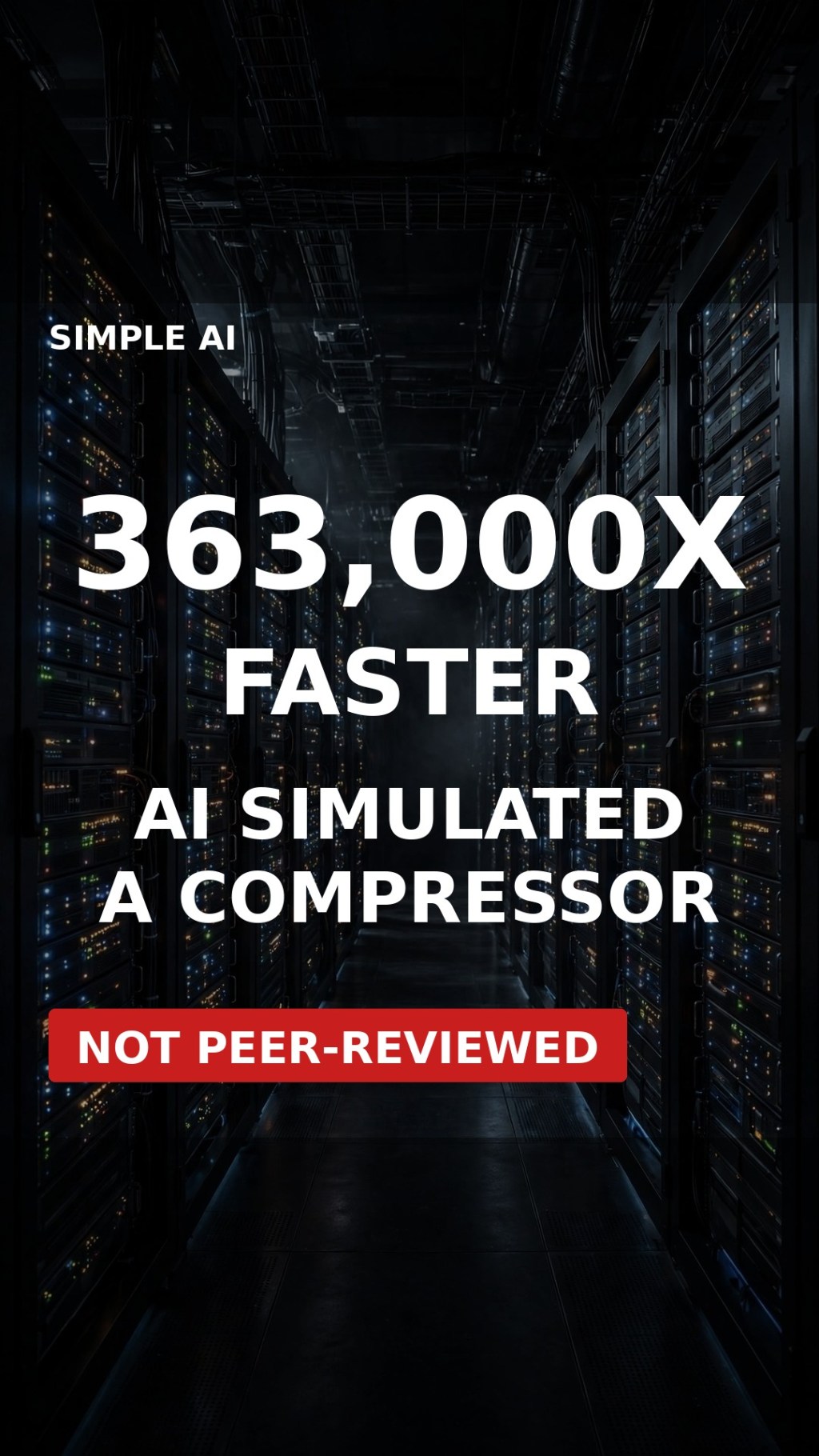
We ran airflow through AI — and it finished 363,000 times faster.
Baker Hughes, Dell and Nvidia tested a physics-informed AI surrogate on centrifugal compressors, the machines at the heart of gas pipelines, LNG plants and refineries. Instead of running a conventional CFD simulation that takes about 12 hours, the AI predicted the full 3D airflow field in about 0.1 seconds — roughly 363,000 times faster, at 99.6% median accuracy. It ran on a Dell Pro Precision workstation with Nvidia’s GB300 chip.
The storyline
Hook: We ran airflow through AI. It finished 363,000 times faster.
Context: Baker Hughes, Dell and Nvidia tested an AI surrogate on centrifugal compressors. It predicted 3D airflow fields — the same job as conventional CFD.
Stakes: The AI hit 99.6 percent median accuracy on a Dell Pro Precision workstation with Nvidia’s GB300 chip. This is a vendor case study, not peer-reviewed science. For engineers, that means testing designs in seconds, not weeks.
Payoff: AI did not replace physics. It made the slow part fast. Send this to one engineer who runs simulations.
Watch next
The Midterm AI selloff — voters rejected new data centers in 40 of 41 votes, and AI stocks fell.
How we verified this
Figures come from the Baker Hughes case study published October 23, 2026 in Oil & Gas Journal: approximately 363,000 times faster inference than conventional CFD, 99.6% median accuracy predicting 3D flow fields, run on Dell Pro Precision with GB300. The “12 hours to 0.1 seconds” framing is the case study’s own comparison. Caveat: this is a vendor case study / white paper, NOT peer-reviewed — a published benchmark from a named customer, not a math result or a Clay Institute decision.
Links
- Instagram reel: https://www.instagram.com/p/DfXj8Z8ApJE/
- Source: Oil & Gas Journal — “How Baker Hughes is levering the Dell AI Factory with NVIDIA to Accelerate Centrifugal Compressor Simulations with Physics-Informed AI” (Oct 23, 2026): https://www.ogj.com/white-papers/whitepaper/55414047/how-baker-hughes-is-levering-the-dell-ai-factory-with-nvidia-to-accelerate-centrifugal-compressor-simulations-with-physics-informed-ai
- https://www.instagram.com/simpleaiexplains/
- https://buymeacoffee.com/simpleaiexplains


Leave a Reply