
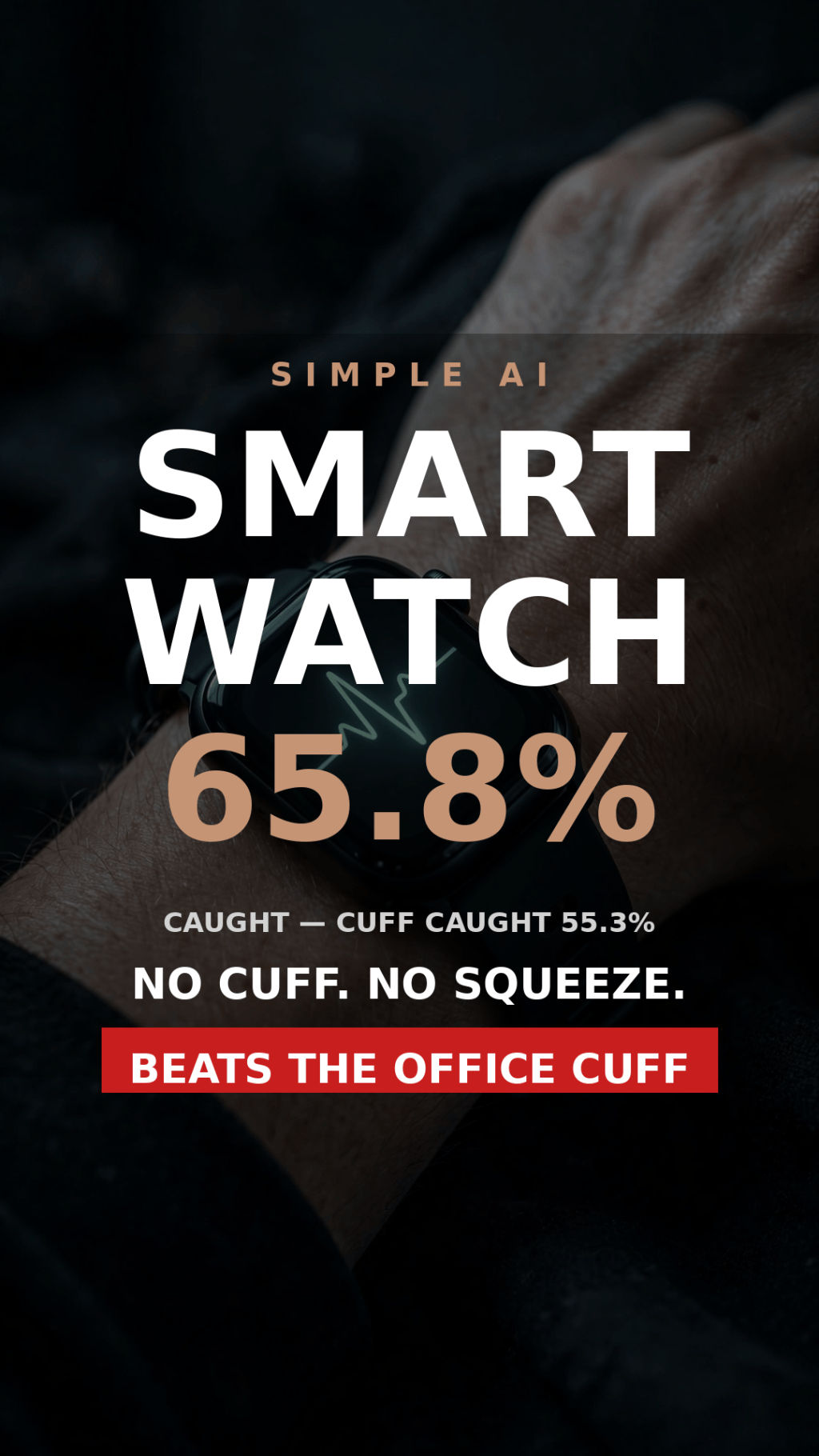
65.8% vs 55.3% — your watch beat the doctor’s cuff.
Google’s AI read a smartwatch’s pulse sensor and flagged high blood pressure without any cuff, no calibration, no arm squeeze. In a 196-person study published in Nature on November 5, the watch caught 66% of hypertension cases over seven days of everyday wear. A single office cuff reading caught 55%. The watch never gives you real blood-pressure numbers — it only answers one question: does this person probably have persistently high blood pressure? And the honest catch: it missed a third of cases, and the gap over the office cuff was small enough that the paper calls the two “comparable”, not better. It screens; it never diagnoses.
The storyline
Hook: 65.8% vs 55.3% — your watch beat the doctor’s cuff.
Context: Google trained an AI on half a million hours of smartwatch data. In a 196-person test published in Nature on November 5, the watch flagged high blood pressure from pulse and motion sensors alone — no cuff, no calibration.
Stakes: The watch caught 66% of cases vs 55% for a single office reading, at the same false-alarm rate — but the gap was not statistically significant, and it missed a third of cases. It reads your pulse shape over days; it never gives real blood-pressure numbers, and it screens, never diagnoses.
Payoff: The cuff is not dead yet, but your watch just joined the checkup. If your watch flags you, confirm it with a real cuff and see your doctor. Would you trust your watch with your blood pressure — yes or no?
Watch next
Meta’s strategy chief Dave Wehner is leaving to become CFO of AI inference startup Fireworks — a $17.5 billion company that already serves models for Cursor, Perplexity and Uber.
How we verified this
Checked against the Nature paper (Di Achille et al., “Opportunistically Detecting Signs of Hypertension on a Consumer Smartwatch”, DOI: 10.1038/s41586-026-11336-3) and Google Research’s own blog post, cross-read with Medical Xpress and the madrobot breakdown: 196 adults at five US sites, seven days of wear, checked against 24-hour ambulatory monitoring; 65.8% sensitivity vs 55.3% for the first office reading at 90.0% specificity; trained on 492,347 hours from 2,109 people. The “not statistically significant” caveat and the missed third of cases are in the paper’s own framing, and they are in the video too.
Links
- Instagram reel: https://www.instagram.com/p/DfdwDJKAU-r/
- Sources: https://medicalxpress.com/news/2026-11-ai-powered-smartwatch-high-blood.html · https://madrobot.blog/2026/11/07/google-smartwatch-ai-high-blood-pressure-nature/ · https://www.androidpure.com/google-smartwatch-hypertension-study/
- https://www.instagram.com/simpleaiexplains/
- https://buymeacoffee.com/simpleaiexplains


Leave a Reply